Online schooling South Africa 2026: why families are switching

The school run is getting longer, the fees are getting steeper and the waiting lists are getting silly. No wonder “online schooling South Africa” is what so many parents are typing at 11pm.
At 8am on 5 August 2026, the Gauteng online admissions portal opened for 2027 Grade 1 and Grade 8 places. By midday it had swallowed 210,055 applications. More than 12,000 parents had been sitting in the digital queue since before 7:30am, coffee in hand, refreshing a page for the privilege of applying for a desk.
That is one South African education story. Here is the other: BusinessTech’s January 2026 round-up of the country’s most expensive private schools found four now charging more than R400,000 a year for matric, with fee increases averaging 6.4% against inflation of 3.5%. Somewhere between those two extremes sit millions of ordinary families doing sums on the back of an envelope.
So it is not surprising that a growing number of them are looking at a third option. Online schooling in South Africa, alongside its older cousin homeschooling, has stopped being the thing your slightly eccentric neighbour does and become a mainstream conversation at the braai. Here is an honest look at why, what the evidence says and how to decide whether it fits your child.
The squeeze: too few desks, too many zeros
Two very different problems, one identical feeling of being stuck.
Start with the numbers. Gauteng’s public system now serves more than 2.4 million learners across 2,111 schools, and TimesLIVE reported in July 2026 that enrolment grew by over 23,000 learners in a single year, the equivalent of about 19 additional schools. Roughly 400,000 Grade 1 and Grade 8 learners were placed through the online system last year. That is a logistics operation, not a choice.
Now the other end. Jacaranda FM reported in 2026 that premier private schools charge as much as R130,000 a year for pre-school and Grade R, rising to over R350,000 by matric. BusinessTech’s list puts Hilton College at R450,893, Michaelhouse at R417,000, Roedean at R413,095 and St Andrew’s College at R409,815 for 2026. Grade R at St Stithians is R132,270. For a five-year-old.
The private school fee is no longer a stretch. For most families it has simply left the building.
Wynand van Heerden, CEO of tutoring and homeschooling provider Edify, told Jacaranda FM that “private schools are becoming unaffordable for the vast majority of the population” and that “homeschooling will continue to increase for the next ten years.” He would say that. But the fee tables agree with him.
Who is actually leaving, and why?
It is not one kind of family, and it is not one reason.
The honest answer is that South Africa does not count home and online learners very well. The Jacaranda FM report put homeschooling at roughly 2% of the country’s 13 million school-age learners, and Edify itself thinks that is conservative. SA Homeschoolers’ own reckoning, working from the 2011 Census and the 2016 General Household Survey, landed at around 100,000 home learners years ago, growing at roughly 10% a year. Nobody has a clean 2026 figure. Treat every number you read, including these, as an estimate.
What we do know is what is pushing. The Karri Parent Survey 2026, which polled 2,780 parents across all nine provinces in March and April, found that 75% have no education insurance and 91% want tighter controls on phones during the school day. Money and attention, in other words. Add safety: the Cape Times reported in September 2026 that Stats SA’s 2026 data shows about 14% of children surveyed reported physical violence from teachers and about 8% from other learners. Those are minorities, but they are not small ones.
And then there is the quieter reason parents give when nobody official is listening: their child is bright and bored, or anxious and shrinking, or a swimmer who trains at 5am, or simply not built for six hours in a plastic chair. Fit, not flight.
The pattern is global. US NCES data shows 3.4% of learners were homeschooled in 2022–23, up from 2.8% pre-pandemic, while full-time virtual school enrolment more than doubled from 0.86% to 1.8%. The pandemic opened a door and a surprising number of families decided they liked the room.
What the evidence says (and what it can’t)
Selection effects are real. So are the results.
Here is where we have to be grown-ups. The research on home and online learning is genuinely mixed, and anyone who tells you otherwise is selling something.
On homeschooling, Brian Ray’s 2017 systematic review in the Journal of School Choice found that the majority of peer-reviewed studies showed positive academic and social outcomes for home-educated learners compared with their institutionally schooled peers. But Ray himself flags the problem: almost none of this research is well controlled. Families who homeschool are, on average, more involved, more resourced and more motivated. That would lift results in any setting.
On online schooling, the American evidence is a cautionary tale about doing it badly. A 2020 study in Educational Researcher found learners who moved to Indiana’s virtual charter schools suffered “large, negative effects” in maths and English. The National Education Policy Center’s 2019 report found United States virtual schools running learner-to-teacher ratios of 44:1 against a national average of 16:1. That is not online schooling; that is a content library with a login.
Unstructured screen time with a workbook attached is not a school. Structure, live teaching and assessment are the whole point.
The more interesting finding is about fit. Bruhn, Campos and Chyn’s 2023 study of 100,000 Los Angeles families found that while remote learning hurt most learners during the pandemic, about one in ten performed better, often those whose parents actively preferred it, possibly because of less bullying or the ability to work at their own pace. Which is exactly what parents who choose it on purpose, rather than having it forced on them by a lockdown, tend to report.
The lesson: outcomes track the quality of the provider and the fit for the child far more than the category. Choose well and it works. Choose a login-and-hope operation and it doesn’t.
Homeschool or online school? They are not the same thing
Same movement, different jobs.
This is the bit most articles blur, so let’s be precise.
Homeschooling means the parent is the teacher, the curriculum manager and the assessor. You choose the materials, set the pace, mark the work and, under the BELA Act, register with your provincial department and arrange assessment at the end of Grades 3, 6 and 9. It is flexible, intimate and demanding. Many families do it brilliantly.
Online schooling means a registered school delivers the curriculum to your child at home: teachers, timetables, assessment, reports and an accredited exit qualification. The learner is at home; the school is not. That is the category Think Digital Academy sits in.
They overlap more than they compete. Plenty of homeschooling families use an online school as their curriculum provider. Plenty of online-school families started out homeschooling and wanted someone else to handle Grade 10 physical sciences. Neither is a retreat from education. Both are a change of venue.
Homeschooling asks the parent to be the school. Online schooling asks the parent to be the parent.
Online schooling South Africa vs the rest: four routes compared
Cost is the first question. It should not be the only one.
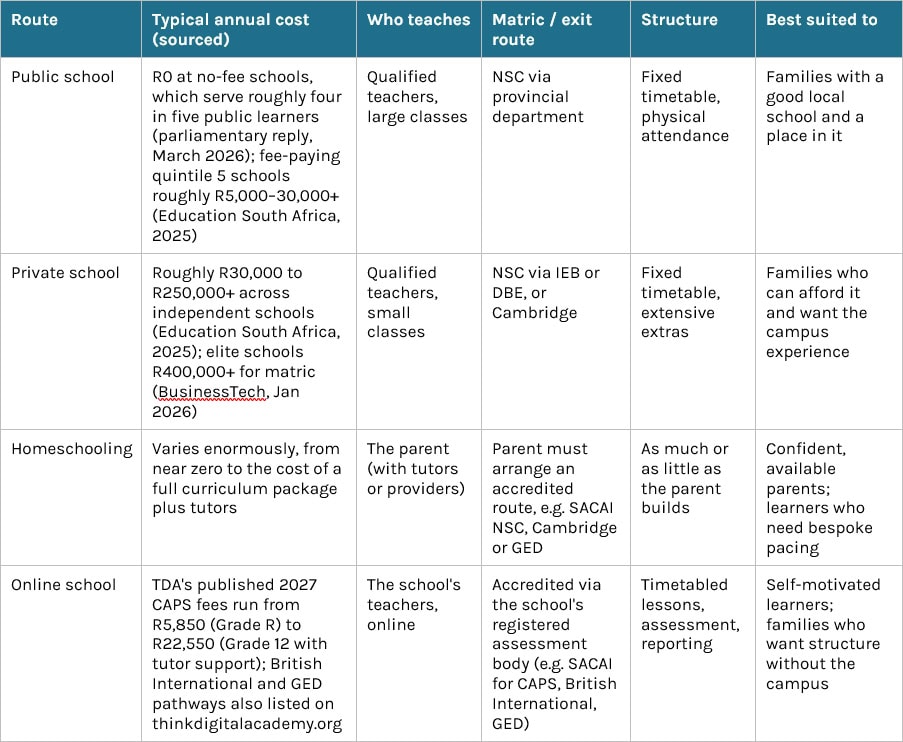
Read that table for the shape, not just the numbers. The cost of online school in South Africa versus a mid-range private school is not a discount. It is a different order of magnitude.
How to choose: five questions before you sign anything
A decision framework, not a sales pitch.
1. Who teaches, and how often? Recorded videos are not teaching. Ask how many live lessons per week, who runs them, what their qualifications are and how quickly a stuck learner gets a human answer.
2. What is the matric pathway, exactly? This is the one that burns families. In February 2026, GroundUp and allAfrica reported on Elshaddai Learning Academy in Brakpan, which advertised classes “from grade RR to 12” while, according to Umalusi, it had not even applied for accreditation. Seventy-five Grade 12 learners were shunted to a sister school in December with almost no notice. Ask which assessment body issues the certificate (SACAI, IEB, DBE, Cambridge, GED Testing Service) and go and check their register yourself.
3. What is the real annual cost? Fees, registration, textbooks, exam fees, devices and data. Compare like with like.
4. What is the structure and where is the socialising? Timetables, deadlines, clubs, camps, sport. A school that cannot answer this is not a school.
5. What does it need from you? Be brutally honest. A Grade 2 learner needs an adult in the room. A Grade 11 learner needs an adult who checks in. If your household cannot supply that, no provider will fix it.
Red flags: “accreditation pending” with no dates; no named assessment body; no live teaching; fees that only exist after a sales call; and any promise that a learner can “skip” the DBE-mandated assessments.
The honest caveat
This is not for every child, and it is not for every household.
Online schooling is not a magic exit. It demands a learner who can, with support, manage their own time, and a home that has a quiet corner, reliable connectivity and an adult who is present in some form. It is harder for very young children, for learners with certain support needs unless the school genuinely provides for them, and for families where both parents are out of the house all day with no backup.
The evidence is muddied by who chooses it. The positive homeschool findings come from motivated families; the negative virtual-school findings come mostly from under-resourced American charter models. Neither tells you what will happen with your child at a well-run online school in South Africa. Only a trial does.
And if your child is thriving at a bricks-and-mortar school you can afford, with friends, a good teacher and a bus that arrives, stay. Fit, not escape.
What good looks like
Think Digital Academy graduates are:
- Learners who can plan a week, hit a deadline and ask for help before the night before.
- Comfortable in a digital workplace because they have been working in one since Grade 4.
- Holders of a recognised qualification: the CAPS NSC through SACAI, the British International curriculum, or the United States GED.
- Used to being taught by a real teacher and marked by a real person, not a bot.
- Young people who have had time for the thing they love, whether that is a sport, a stage or a startup.
Ready to see it for yourself?
Think Digital Academy has been named Virtual School of the Year five times running (2020 to 2024) and offers three accredited curricula online: the British International curriculum, the South African CAPS curriculum through SACAI, and the United States GED. The 2027 fees are published in full on our site. If you want to know whether it fits your child, request a free trial and let them try it. That is the only research that really counts.
Free trial
Experience Think Digital Academy’s award-winning online school with a free 14-day trial. Start your free 14-day trial today.