Why the best schools in 2026 look nothing like schools
The building hasn’t changed much in a century. The learning inside it has changed completely.
Picture a classroom. Go ahead, close your eyes for a second and picture it. Odds are you’re seeing rows of desks, a whiteboard at the front, fluorescent lighting, a teacher standing with their back half-turned to the room. You might be picturing your own childhood classroom. Or your child’s. Here is the uncomfortable truth: they would be almost indistinguishable.
For all the conversations about education reform, for all the conferences and curricula rewrites and edtech pitches, the container that holds most children’s learning has barely moved in a century. The bell still rings. The rows still face forward. The model still assumes that knowledge flows in one direction: from the front of the room, outward.
But something is shifting. And it is shifting fast.
The institutions that are genuinely transforming education right now don’t look like schools at all. They look like studios, like game environments, like newsrooms, like something a ten-year-old might design if you asked them how they’d most like to spend the next six hours learning. They are flexible, personalised, digitally rich and increasingly, they have no physical address whatsoever.
The architecture of boredom
There is a reason so many children describe school as boring, and it is not because they are intellectually incurious. Children are, by nature, relentlessly curious – they ask why before they can read, they investigate before they are told to, they learn through play with a ferocity that most adults have long since had trained out of them.
The architecture of the traditional school, both physical and pedagogical, is quite good at suppressing that. Desks facing forward. Thirty children expected to progress at the same pace. One teacher managing the competing needs of an entire room. A 40-minute period that ends regardless of whether understanding has arrived. A system designed, as many educators now openly acknowledge, for an industrial economy that no longer exists.
Research published in 2025 in the journal Learning Environments Research, examining 23 secondary schools across Australia and New Zealand, found that students in schools with innovative, flexible designs showed meaningfully greater adoption of deep learning compared to those in traditional settings. The physical and pedagogical environment is not neutral. It shapes how and how well children think.
|
49% |
900% |
84% |
Those numbers aren’t a pandemic blip. The global e-learning market is projected to hit $400 billion by 2026. More telling still: over half of higher education institutions worldwide now report that online programme enrolment is outpacing on-campus growth. Parents are voting with their children’s futures and increasingly, they are voting for something different.
What the new model actually looks like
The phrase “online school” still carries, for some parents, a faint whiff of compromise. As though choosing it represents a step back from something more legitimate. This perception deserves to be interrogated and then retired.
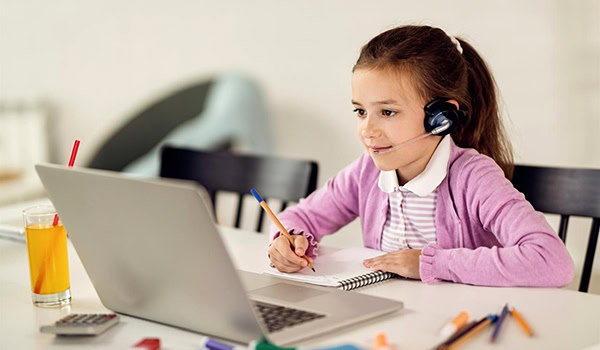
What the best virtual schools have built is not a digital replica of the traditional classroom. It is something architecturally different. Consider what a modern online school actually offers a child on any given morning: pre-recorded lessons taught by subject specialists – not a generalist teacher managing thirty competing needs, but an expert who has refined their explanation until it is genuinely excellent. Printable notes. Instant feedback on assessments. A student success coach available when motivation flags. A tutor reachable within fifteen minutes when a concept won’t click.
This is not a lesser version of education. In many respects, it is a more attentive one.
The research on engagement
A comprehensive meta-analysis published in Frontiers in Psychology, examining over 5,000 students across 41 studies, found that gamified and interactive learning environments produced a significantly large positive effect on academic performance. Critically, the effect was strongest for younger learners – exactly the age group most failed by passive, one-size-fits-all instruction.
The most forward-thinking online institutions have understood something crucial: engagement is not a nice-to-have. It is the mechanism through which learning actually occurs. A child who is bored has not merely failed to enjoy their lesson – they have failed to encode it. Engagement is structural.
Gamification, flexibility and the death of the bell curve
One of the most significant evolutions in modern online schooling is the integration of game-design principles into learning. Not “educational games” in the slightly earnest, CD-ROM sense of the 1990s, but the underlying mechanics that make games so powerfully compelling: immediate feedback, visible progress, challenge calibrated to ability, the satisfaction of mastery.
The data on this is striking. Challenge-based gamification has been shown to improve student performance by close to 90% compared to traditional lecture-based delivery. A Federation of American Scientists study found that when students actively perform tasks alongside instruction – rather than passively receiving information – retention jumps from 20% to 90%. The child who does the thing remembers it. The child who watches someone else do the thing, mostly doesn’t.
Flexibility compounds this. When a child encounters a concept they find difficult, the traditional classroom moves on. The next lesson begins; the gap remains. In an adaptive online environment, the child can revisit, replay, approach from a different angle, without the social exposure of being the one who doesn’t understand, without the time pressure of thirty others waiting. This is not a small thing. It is, for many children, the difference between falling behind and keeping pace.
But what about socialisation?
This is the question every online school parent fields at the dinner table. It is worth taking seriously and worth answering honestly.
The honest answer is that the concern, while understandable, is frequently misplaced. Physical proximity has never been the same thing as meaningful connection. Many children in traditional schools are profoundly isolated – surrounded by peers and still lonely, bullied into silence or simply made invisibile by the demands of a large, impersonal classroom. The question is not whether children are in a room together, but whether they feel genuinely known, supported and connected.
The best virtual schools have built this deliberately. Student forums, virtual clubs, meet-and-greets, matric dances – the social infrastructure of school, reimagined for a digital native generation. The child who joins an art club, a robotics team or a dance club is not being deprived of social development. They are experiencing it through a different medium – one that, for many children, feels far safer and more authentically themselves.
The parent’s real question
Underneath most parents’ uncertainty about online schooling sits a single, reasonable question: Will my child be okay? Will they be academically equipped? Will they be socially whole? Will the certificate they earn at the end open the doors it needs to open?
These are not abstract anxieties. They are the right questions. And they deserve direct answers.
Academically: a well-designed online school, with qualified subject teachers and assessors, structured assessment and robust reporting, can match and in key respects exceed, what a traditional school delivers. Quarterly and term reports from leading virtual schools are recognised by government and private schools globally. Students completing internationally recognised qualifications can and do proceed to university, locally and abroad.
Socially: the evidence increasingly suggests that the richness of a child’s social experience depends far less on the format of their schooling and far more on the intentionality with which connection is cultivated. Online schools that take this seriously, that build clubs, communities and genuine peer interaction into the fabric of the experience, are producing socially capable, emotionally intelligent young people.
And the certificate? Internationally recognised curricula – British International, South African CAPS, United States GED – carry exactly the same weight from an online school as from a traditional one, provided the institution is properly accredited.
What to look for in an online school
Not all virtual schools are equal. The markers of quality are: formal accreditation and curriculum registration, qualified subject tutors, teachers and assessors (not just content delivery), dedicated student support beyond academics, transparent reporting to parents and a proven record of student outcomes.
The shift that has already happened
Here is what is easy to miss when you’re standing inside a system: the revolution doesn’t announce itself. It accumulates. Parents make quiet choices. Children thrive in unexpected environments. A new normal assembles itself, piece by piece, until one day the old model seems not merely outdated but faintly absurd.
That is where we are with education in 2026. The best schools no longer look like schools because the best learning no longer works like the model schools were built around. The one-to-many, bell-scheduled, desk-forward classroom was a reasonable solution to a particular set of constraints – mass education with limited technology and a workforce that needed standardised output. Those constraints have dissolved.
What has replaced them is something more interesting: the possibility of education that is genuinely responsive to the individual child. That moves at the pace of their understanding. That is delivered by specialists, supported by coaches, enriched by technology and freed from the geography that used to make choice impossible.
The best schools in 2026 look nothing like schools. They look like the future of learning which, it turns out, looks a lot like what children have always needed.
- Learning paced to the individual child, not the middle of the class
- Subject experts delivering content, not generalists stretched thin
- Immediate feedback loops that close gaps before they compound
- Student wellness coaches available when motivation wavers
- Internationally accredited qualifications that open the same doors
- Social community built and engineered intentionally, not assumed by default
- Freedom to learn from anywhere in the world
The question for parents in 2026 is no longer whether online schooling is legitimate. It is whether the traditional model is still the best one available and whether, for your child, there might be something considerably better.
Free trial
Give your child a 14-day head start on the future. Experience Think Digital Academy’s award-winning online school with a free 14-day trial. British International, South African CAPS and US GED – all in a world-class virtual environment. Start your free 14-day trial.