• Free trial
  • Enrol
  • Login
International online school - study from anywhere in the world
Think Digital Academy
  • About
    • About us
    • Our key services
    • Prospectus
    • Accreditation and certification
    • Countries and regions
    • Awards and recognition
    • Reviews
    • Media releases
    • Contact us
  • Curricula
    • British International
      • Overview
      • Early Years – Stage R
      • Lower Primary (Stages 1 – 3)
      • Upper Primary (Stages 4 – 6)
      • Lower Secondary (Stages 7 – 8)
      • GCSE
      • AS Level
      • FAQs
    • South African CAPS
      • Overview
      • Primary (Grades R – 7)
      • High (Grades 8 – 12)
      • Adult Matric
      • FAQs
    • United States GED
      • Overview
      • FAQs
  • Courses
    • Winter School – Maths and Science for matrics
    • Coding and Robotics
    • Mind Power for Kids
    • Mind Power for Teens
    • Social Media for Kids
    • Social Media for Teens
  • Fees
    • Annual tuition fees
    • Short course and winter school fees
    • Special offers
  • Info
    • How to get started
    • Stationery and equipment
    • Suggested school terms
    • Glossary of terms used
  • FAQs
    • General
    • Fees and payment
    • Cambridge International
    • South African CAPS
    • United States GED
  • Read
    • Think Tank blog
    • Reading Room
    • Think Digital News
  • Social
    • About our clubs
    • Art Club
    • Cartoon and Anime Club
    • Dance Club
    • Drama Stars Club
    • Jewels and Jems Club
    • Mathletes Club
    • Movement Society
    • Pilates Club
    • Science Club
    • The Zen Club
    • Time Travellers Club
    • Yoga Club
  • Hubs
    • Find a coaching hub
    • Register a coaching hub
  • Click to open the search input field Click to open the search input field Search
  • Menu Menu
Think Tank

The neuroscience of screen time: what research actually says about online learning
Online schooling, Tips for parents
"But what about all that screen time?" The question haunting parents of online students, the concern that keeps them scrolling forums.

Spoiler alert: Your kid’s brain is doing just fine.

“But what about all that screen time?”

It’s the question haunting every parent of an online student. The one your mother-in-law whispers at Sunday lunch. The concern that keeps you scrolling parenting forums at midnight.

Here’s what nobody’s telling you: neuroscience doesn’t back up the screen time panic. What research actually shows is that screens aren’t frying your child’s brain. What matters is what they’re doing on those screens.

Not all screen time is created equal

Most “screen time” research lumps everything together: TikTok doom-scrolling = live classroom discussions = educational games = staring blankly at YouTube. It’s like saying “food” and treating birthday cake and broccoli as identical.

Dr Michael Rich, director of the Centre on Media and Child Health at Boston Children’s Hospital, says it best: “Asking if screen time is bad for kids is like asking if food is bad. It depends entirely on what kind.”

The distinction that matters? Passive consumption versus active engagement. Mindless versus purposeful. Isolated versus connected.

What’s actually happening in your kid’s brain

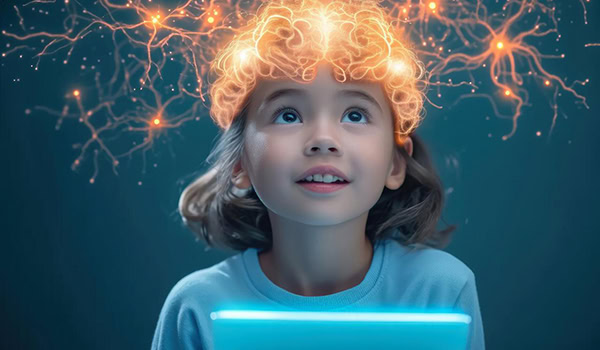
When students engage in active online learning such as discussing, problem-solving, creating, their brains light up. Functional magnetic resonance imaging (fMRI) studies show activation in the prefrontal cortex (critical thinking), hippocampus (memory) and temporal lobe (language processing).

Even better: interactive digital learning activates additional neural pathways for spatial reasoning and hand-eye coordination. Students aren’t just learning content, they’re developing digital literacy, a form of multiliteracy that includes navigating complex interfaces, evaluating information and communicating across platforms.

A 2023 study in Frontiers in Psychology found students in well-designed online environments showed equal or superior executive function development compared to traditional students. Key words: well-designed. Not all online learning is equal, just like not all schools are equal.

The real threats (hint: not screens)

While everyone panics about screens, science points to completely different culprits:

Chronic stress literally shrinks the hippocampus and blocks neuroplasticity. High-pressure traditional school environments keep cortisol levels elevated for hours, disrupting memory and emotional regulation.

Sleep deprivation from rigid schedules that ignore teenage circadian rhythms devastates cognitive function. One extra hour of sleep improves academic performance more than any educational intervention studied.

Social isolation triggers the same brain regions as physical pain. Plot twist: many students report feeling more connected in thoughtfully designed online environments than sitting silently in rows of desks.

Lack of autonomy suppresses dopamine and kills intrinsic motivation. When students have no choice in what, when or how they learn, their brains literally check out.

The attention span myth

That viral claim about goldfish having longer attention spans than today’s students? Based on a misinterpreted Microsoft study that never actually studied attention spans.

What has changed is selective attention – the ability to filter signal from noise in information-rich environments. This isn’t a deficit; it’s an adaptation. Today’s students have developed sophisticated filtering mechanisms to navigate complex digital landscapes and rapidly assess information quality.

Dr Adam Gazzaley, neuroscientist at UC San Francisco, argues that what adults perceive as shortened attention is actually enhanced selective attention. Students aren’t losing focus – they’re becoming more discerning about what deserves it.

The neuroplasticity advantage

Here’s the kicker: the human brain doesn’t distinguish between “natural” and “technological” learning. Neuroplasticity doesn’t care. What matters is engagement, challenge and meaningful practice.

Digital learning offers something traditional classrooms struggle with: immediate feedback loops. Instant feedback strengthens neural pathways through rapid reinforcement.

Interactive simulations let students manipulate variables and observe consequences in real-time. You can’t dissect a frog twenty times in biology class, but you can digitally – each iteration strengthening procedural memory without physical limits.

Multimedia learning, designed according to cognitive load theory, actually reduces mental effort compared to text-only instruction. Dual coding-processing through visual and verbal channels, creates redundant neural pathways that boost retention.

What parents should actually focus on

Forget the screen time counter. Ask better questions:

  • Is it active or passive? Are they creating, problem-solving and collaborating or just clicking through content?
  • Is it social or isolating? Are there meaningful peer interactions or are they alone with a computer?
  • Is it engaging or soul-crushing? Does learning spark curiosity or dread?
  • Is there balance? Room for physical activity, hands-on learning, offline experiences?

These questions matter infinitely more than hours on a screen.

The bottom line

Your child’s brain isn’t being damaged by quality online education. It’s being prepared for a world where digital fluency is as fundamental as reading.

The students who’ll thrive tomorrow aren’t those who avoided screens; they’re those who learned to use screens as tools for creation, connection and continuous learning. Students who developed self-regulation, digital citizenship and independent learning skills. Students who discovered education isn’t something done to them in a building, but something they can access anywhere, anytime.

The screen time panic is a distraction. The real questions are: Is this meaningful? Is my child engaged? Are they developing the skills they’ll actually need?

When the answers are yes, screens aren’t the problem. They’re the future.

Free trial

Ready to see what brain-friendly online learning looks like? At Think Digital Academy, we don’t just stick traditional school on a screen – we’ve reimagined education for how young minds actually work. Why not try our online learning environment by enroling for our free 14 day trial. Discover why our students are thriving academically, socially and neurologically.

Great reading

  • Socialisation in online schools: How Think Digital Academy helps students build friendships and communities
  • The digital dilemma: a balanced approach to online learning
  • 10 Reasons why online schooling is the future of learning
November 28, 2025
Share this entry
  • Share on Facebook
  • Share on X
  • Share on WhatsApp
  • Share on LinkedIn
  • Share by Mail
https://www.thinkdigitalacademy.org/wp-content/uploads/2025/11/The-neuroscience-of-screen-time.jpg 350 600 vene https://www.thinkdigitalacademy.org/wp-content/uploads/2020/10/logo_shrinking.png vene2025-11-28 12:49:212025-12-23 09:00:18The neuroscience of screen time: what research actually says about online learning

Recent Posts

  • Why the best schools in 2026 look nothing like schools
  • School is preparing your child for a world that no longer exists
  • Books for super-hero kids who want to save the world
  • Your five-year-old isn’t behind – the system might be
  • Beyond traditional walls: why online learning is reshaping education

Categories

British International curriculum
International education
Online schooling
South African CAPS
Tips for parents
United States GED

The future is digital

Think Digital Academy is the first international virtual school providing a state of the art e-learning environment. We provide the United States GED, British International and South African CAPS curricula in an integrated, engaging and effective way.

© Copyright – Think Digital Academy.
All rights reserved.

Website created and maintained by Studio Vene Design

Connect with us

Email hello@thinkdigitalacademy.org

Regional office phone numbers
United States +1 (239) 238-4411
South Africa +27 (012) 998-1472
WhatsApp
English +27 071 408 4677
Afrikaans +27 067 912 7838
Request a call back

Terms and conditions | Privacy policy
Copyright notice | PAIA | Sitemap

Subscribe

Link to: Seeing dyslexia differently: how audio lessons open doors for every learner Link to: Seeing dyslexia differently: how audio lessons open doors for every learner Seeing dyslexia differently: how audio lessons open doors for every learnerDyslexic learners thrive at Think Digital Academy. Link to: Deck the halls with learning: your ultimate guide to festive family fun this holiday season Link to: Deck the halls with learning: your ultimate guide to festive family fun this holiday season Read our ultimate collection of festive activities that’ll keep your kids entertained, engaged and sneakily learning throughout the holiday.Deck the halls with learning: your ultimate guide to festive family fun this...
Scroll to top Scroll to top Scroll to top

Nom Nom Nom we THINK cookies are delicious. This site uses cookies. By continuing to browse this site, you are agreeing to our use of cookies.

I love cookiesCookies are grossLearn more

Cookie and Privacy Settings


How we use cookies

We may request cookies to be set on your device. We use cookies to let us know when you visit our websites, how you interact with us, to enrich your user experience, and to customize your relationship with our website.

Click on the different category headings to find out more. You can also change some of your preferences. Note that blocking some types of cookies may impact your experience on our websites and the services we are able to offer.

Essential Website Cookies

These cookies are strictly necessary to provide you with services available through our website and to use some of its features.

Because these cookies are strictly necessary to deliver the website, refusing them will have impact how our site functions. You always can block or delete cookies by changing your browser settings and force blocking all cookies on this website. But this will always prompt you to accept/refuse cookies when revisiting our site.

We fully respect if you want to refuse cookies but to avoid asking you again and again kindly allow us to store a cookie for that. You are free to opt out any time or opt in for other cookies to get a better experience. If you refuse cookies we will remove all set cookies in our domain.

We provide you with a list of stored cookies on your computer in our domain so you can check what we stored. Due to security reasons we are not able to show or modify cookies from other domains. You can check these in your browser security settings.

Other external services

We also use different external services like Google Webfonts, Google Maps, and external Video providers. Since these providers may collect personal data like your IP address we allow you to block them here. Please be aware that this might heavily reduce the functionality and appearance of our site. Changes will take effect once you reload the page.

Google Webfont Settings:

Google Map Settings:

Google reCaptcha Settings:

Vimeo and Youtube video embeds:

Privacy Policy

You can read about our cookies and privacy settings in detail on our Privacy Policy Page.

Privacy policy
I love cookiesCookies are gross