

Introduction
Few storytellers have shaped English literature quite like Charles Dickens. For nearly 200 years his novels have introduced readers to clever orphans, kind-hearted friends, sneaky scoundrels and some of the most memorable characters ever put on a page. Classic Tales by Charles Dickens brings a selection of his best-loved works into the Think Digital Academy Reading Room in a form young readers can genuinely enjoy.
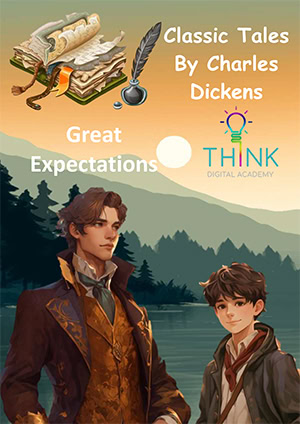
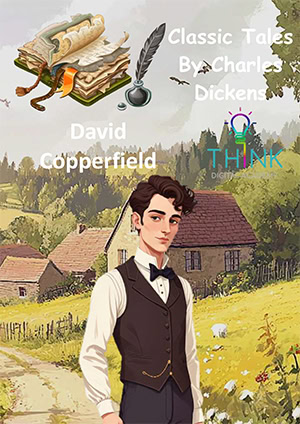
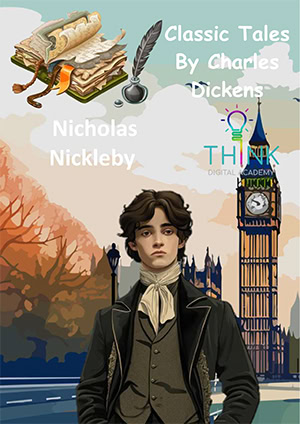
The series features Great Expectations, David Copperfield and Nicholas Nickleby: three sweeping stories of orphans and underdogs who face hardship with courage and come through with their goodness intact. Readers will wander bustling Victorian streets, peer into grand houses and follow surprising journeys where friendship matters and goodness ultimately triumphs.
Think Digital Academy curates classic literature like this because the classics do something special for developing readers. They stretch vocabulary, introduce richer sentence structures and give learners a shared cultural reference point that pays dividends right through high school, where Dickens frequently appears as a set work. Meeting these stories early, in an accessible format, turns later study into a reunion rather than a struggle.
The collection is ideal for confident primary readers and high school learners alike, whether they are reading for pleasure at home, building literary knowledge in a homeschool programme, or preparing for formal literature study. Each tale is available as a free children’s stories PDF in both English and Afrikaans, so families can download, print and read together, and Afrikaans readers can enjoy the classics in their home language too. If you are looking for classic stories for kids that combine adventure, humour and big-hearted moments, Dickens remains very hard to beat.
Why classic literature improves reading
Classic novels are a workout for the reading brain. Dickens’ rich Victorian vocabulary stretches word knowledge well beyond everyday language, and encountering unfamiliar words in vivid context is one of the most effective ways children acquire them. His longer, layered sentences build the parsing skills learners need for academic texts across all subjects. Plot threads that weave together over many chapters develop reading stamina and train readers to hold information in mind, track multiple characters and make connections, all core comprehension skills. Dickens is also a masterclass in inference: his heroes and villains reveal themselves through speech, habit and telling detail, so readers constantly practise judging character from evidence. Finally, his themes of poverty, injustice and kindness build empathy and give readers meaningful moral questions to discuss long after the final page.
Recommended age
These retellings suit readers aged roughly 10 to 15, corresponding to Grades 5 to 9 in the South African CAPS curriculum and Years 6 to 10 on the British International curriculum. Younger confident readers will enjoy the adventure and humour, while older learners can use the series as an approachable introduction before tackling the full novels in high school.
Curriculum alignment
For CAPS learners, this series supports the Reading and Viewing outcomes of Home Language and First Additional Language in the Intermediate Phase (Grades 4 to 6) and especially the Senior Phase (Grades 7 to 9), where learners study character, plot, setting and theme in extended fiction. It also lays excellent groundwork for FET (Grades 10 to 12) literature study, where classic novels are prescribed. The dual-language PDFs make the series a valuable resource for Afrikaans reading practice, whether Afrikaans is a learner’s Home Language or First Additional Language.
For the British International pathway, the series aligns with Key Stage 2 and Key Stage 3 English objectives: reading a wide range of fiction including classic literature, understanding how language and structure create meaning, and developing an appreciation of the English literary heritage.
Reading skills developed
- Advanced vocabulary: Victorian settings and formal registers introduce rich new words in context.
- Reading stamina: longer, chaptered narratives train sustained concentration.
- Character analysis: Dickens’ vivid heroes and villains give readers ideal practice in judging character from evidence.
- Inference: readers deduce motives and secrets from dialogue, description and telling details.
- Tracking complex plots: interwoven storylines strengthen sequencing and memory skills.
- Understanding historical context: Victorian England builds background knowledge that supports comprehension across subjects.
- Theme and moral reasoning: questions of justice, kindness and social class invite thoughtful discussion.
Story summaries and PDF downloads
Each Dickens tale in this series can be downloaded as a free PDF, ready to print or read offline.
More great reading
Subscribe to our mailing list to ensure you don’t miss out on any of our upcoming books and stories.
The future is digital
Think Digital Academy is the first international virtual school providing a state of the art e-learning environment. We provide the United States GED, British International and South African CAPS curricula in an integrated, engaging and effective way.



© Copyright – Think Digital Academy.
All rights reserved.
Website created and maintained by Studio Vene Design
Connect with us
Email hello@thinkdigitalacademy.org
Regional office phone numbers
United States +1 (239) 238-4411
South Africa +27 (012) 998-1472
WhatsApp
English +27 071 408 4677
Afrikaans +27 067 912 7838
Request a call back


Terms and conditions | Privacy policy
Copyright notice | PAIA | Sitemap